Every word of the visit, captured. Every touch of the chart, governed.
AI Ambient Scribe listens to the visit and builds a transcript. AI Notes Draft turns that transcript and the chart into a SOAP note ready for sign-off. Both run as agents on Parapet, so the EHR access behind them is scoped to the encounter, logged, and revocable — not a standing integration with the keys to every chart.
Independent specialty practices rarely have an in-house scribe. The note gets written after hours, from memory, or copy-forwarded from the last visit — and ambient dictation tools that exist today are usually billed per minute and given standing access to the whole chart to do it.
The scribe is an agent, not a bolt-on.
AI Ambient Scribe and AI Notes Draft run through Parapet's own agent runtime. The same discovery, permissioning and audit trail Parapet gives every other agent applies here: the scribe can request a transcript, the drafting agent can request the encounter's chart data, and neither can quietly hold more than that. Compute is self-hosted, so cost is infrastructure, not a per-minute meter on your patients' voices.
Note drafting stays template-first by default — deterministic, instant, and free. An AI-assisted draft only runs when a clinician explicitly asks for one, grounded in the full visit transcript and chart, never on a schedule and never automatically.
Two agents, one chart, one set of guardrails.
Ambient Scribe handles the room. Notes Draft handles the chart. Parapet handles what either of them is allowed to touch.
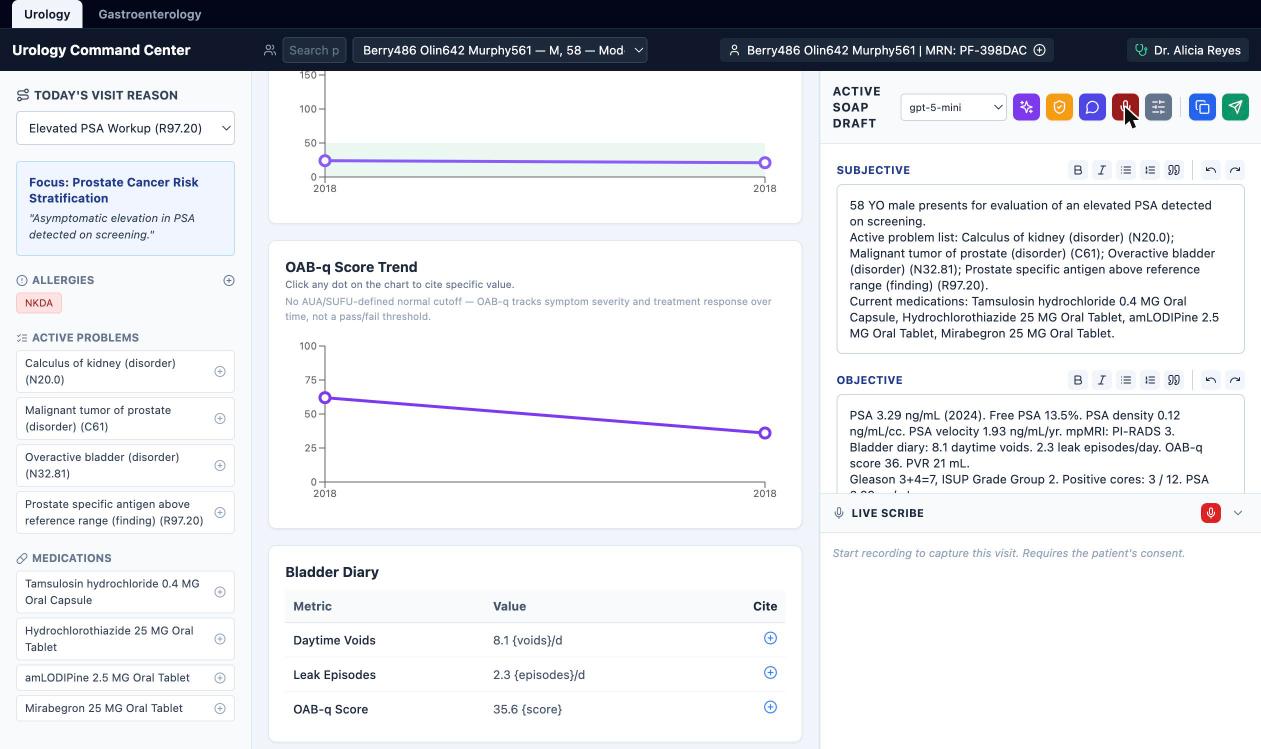
Captures doctor-patient audio from the browser mic with an explicit on-screen consent step, transcribes it locally on self-hosted, open-source models — no per-minute speech API, no audio leaving your infrastructure.
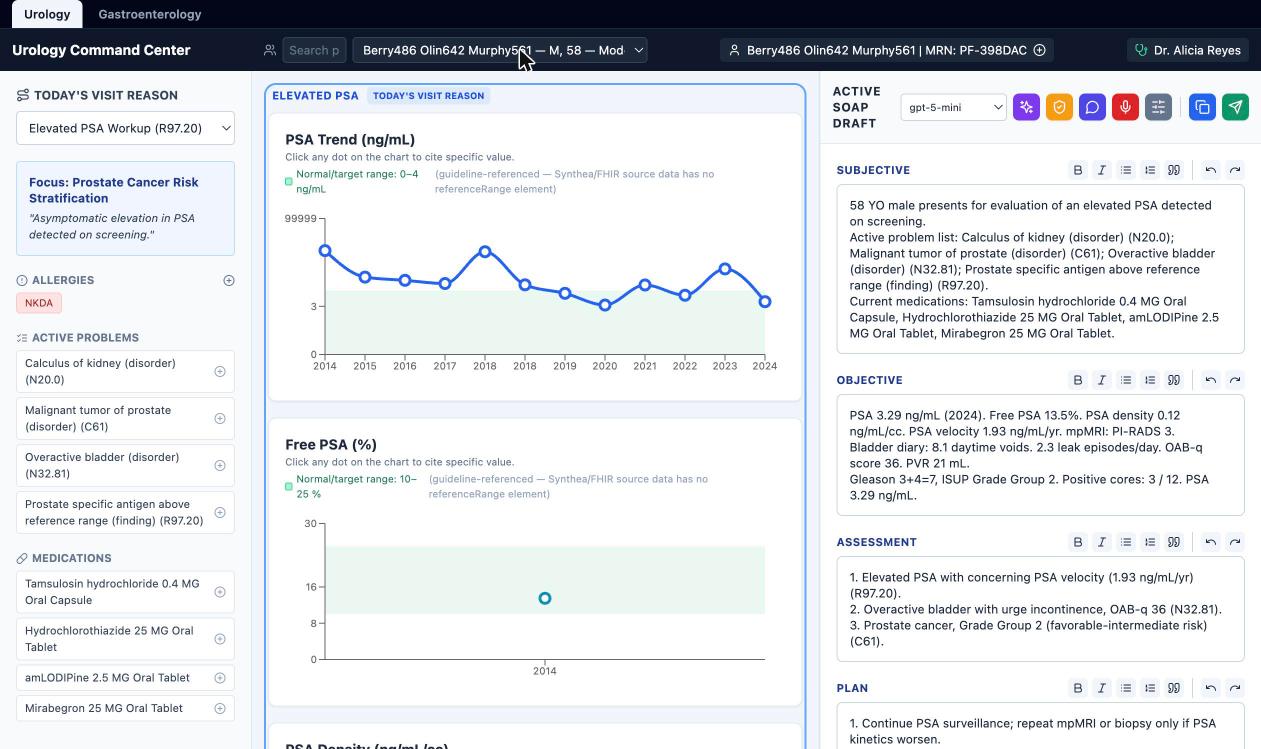
Merges every active problem the chart supports into one SOAP note using deterministic, guideline-based rules first. A clinician can trigger a richer AI-assisted draft grounded in the full transcript and chart at any point — never on its own.
The actual product, on a synthetic chart.
Screenshots below are from the running Urology Command Center against a Synthea-generated synthetic patient — not a mockup, and not a real patient.
HIPAA is Parapet's problem, not your integration's.
The same control plane that scopes and logs every other agent on Parapet applies to Ambient Scribe and Notes Draft, so the compliance work doesn't get re-solved per specialty or per EHR.
Every read or write is tied to the active encounter and the clinician who opened it — never a standing grant across the whole patient panel.
Business associate agreement in place, with encryption in transit and at rest for audio, transcripts and notes.
Agents request only the FHIR resources a given note needs, discovered and inventoried the same way any other Parapet agent's permissions are.
Who ran the agent, what it read, what it wrote — reviewable per encounter, not reconstructed after the fact.
Recommended retention: raw audio is discarded once a transcript is finalized; the transcript and resulting note are what persist.
Any FHIR R4 + SMART on FHIR EHR.
Parapet reads and writes through standard FHIR resources, so it isn't locked to one vendor's proprietary API.
Two specialties, live now.
Ambient Scribe and Notes Draft already recognize the visit pathways below — the note engine knows which findings, labs and thresholds matter for each one.
Ten pathways, from a routine visit to active oncology surveillance.
Nine pathways, from reflux management to GI bleed workup.
See it on a real chart.
Bring a Practice Fusion or Athena Health sandbox and we'll show you the note it drafts, the transcript it built from, and the exact FHIR calls behind both.